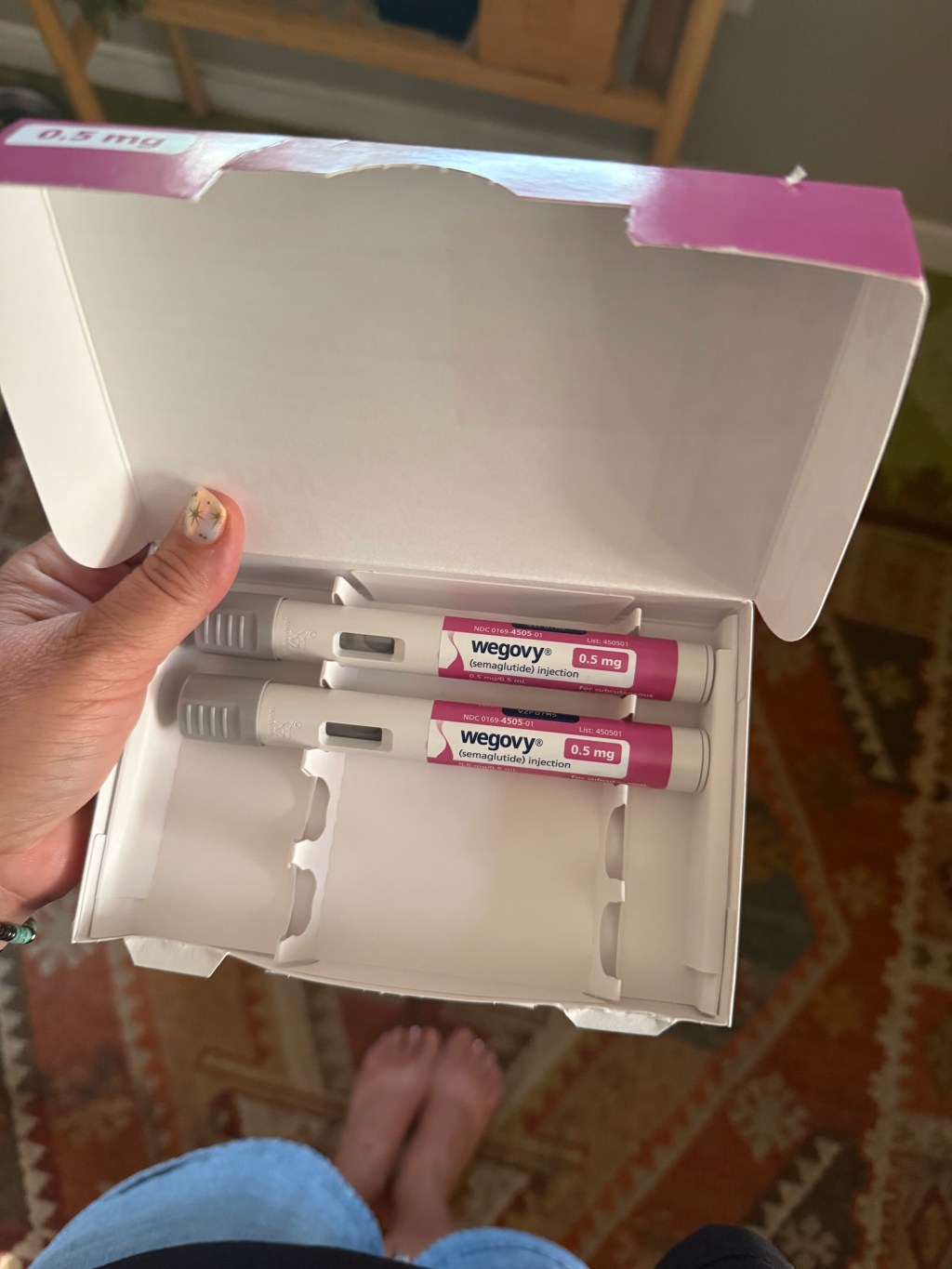
I shared this news in my Instagram stories a month or so back. I started on Wegovy in June after returning from our France/Netherlands vacation. This choice was made after years of back and forth with my various doctors. My GP and my hormone clinic, especially, have been encouraging me to get on the semaglutide train for years because of my rising A1C.
During those appointments, I was pretty insistent on relying on lifestyle modifications to make improvements—which I did have some success with by reducing my alcohol intake. I also found that when I started hormone replacement therapy (HRT) in 2023, my weight FINALLY stopped inching upwards. After years of gaining 1/2 to 1 lb. a year, I was finally maintaining a consistent weight. And while that was technically still in the “obese category” according to BMI, I was happy with my body. After a lot of work and deconstruction on patriarchy and unrealistic beauty standards, I was more accepting of myself than I had in my entire life which is why it was even harder for me to consider going on an Ozempic-type drug.
After all that work, do I just give up and take a shot?
Is it because of my A1C or is it to “be skinny”?
I’d also heard the stories from users of not having an appetite. I’d seen the dramatic weight losses happen within months. I was concerned that a drug like this would put me at a permanent calorie deficit (something that triggers me from my Weight Watchers days) and I wouldn’t have the energy for the sports and activities that I enjoyed.
“I’ll handle it with lifestyle modifications.” That was always my reply when the topic of the drugs came up. And last year, I’m happy to report, I got my A1C back in the healthy range through lifestyle modifications.
Then January hit.
January was super hard for two reasons. The first was Operation Metro Surge and the collective harm the ICE raids did on our community. The second factor was starting my job search. After a joyful 6-month sabbatical, it was time to start searching for work and the stories I’d heard from the unemployed streets were proving very true. It was (still is!) brutal out there. Application after application sent, silence in response. Our community in pain and my source of income in question.
January was hard. Self-soothing behaviors commenced.
At the end of the month, I had a follow-up with my hormone doctor. I went in for my blood panel. And, sure enough, my A1C had gone back up into the pre-diabetic range. At this point, the hormone clinic went into hard-sell mode for a compounded GLP-1 solution. They told me my inflammation was off the charts and that I’d be happier if I lost weight. This is also a for-profit clinic, so my spidey-senses were raised. Was this push about my health, or was it about selling a $600 drug also reaffirming patriarchal beauty standards?
After that session, I called my GP for a second consult. I shared the blood panel results. We had a good but hard conversation. My doc said a semaglutide would actually be her recommendation, but she also understood my concerns and hesitation with choosing this option. She told me that I could continue to give the lifestyle modification thing a try but I needed to commit. No more giving up just because life gets hard. I can no longer continue to self-soothe the stress away with drinking and other unhealthy behaviors like couch-rotting and uncontrolled screen time. I needed to work on that. I heard what she was saying. I had given up in January when everything felt so awful. But I was willing to give it another go.
Then in March, I found a new hormone/menopause doc. I didn’t love my experience with the for-profit hormone clinic. The original practitioner who was the reason I started going there at the beginning of my menopause journey left a while ago. And the specialist that I had been seeing for the past year was suddenly absent with no return date identified. This felt somewhat sketchy, so I once again began searching for another informed menopause-focused doctor.
The good news is that there has been a lot of progress since my original journey for peri-menopausal help a number of years ago. There are a few more doctors in the Allina network with “menopause” listed as a specialty. And this new doc that I found had a wait list, but I got in on someone else’s cancellation. I am really happy with the new doc. She supports HRT, she’s informed of the studies, where menopause training has fallen short in the past and is engaged in continuous education around the specialty.
And it was this conversation that finally convinced me to give GLP-1 a try.
Why? Well, to give a little context, I paid out of pocket for two preventative screenings last year. I had both the DEXA bone density scan and the CT heart ultrasound. Both of these tests typically are only covered by insurance when you are in your 70s. But if you wait until that age for the information, your ability to impact the results is limited. It’s much easier in your 50s to address concerns with low bone density and plaque on arterial walls. So I paid the out-of-pocket costs and had both scans done.
For the most part, my results were good. I have good bones. And I have just a little plaque in one artery. With that CT ultrasound, you get a calcium score and that score can be used to predict your level of risk for heart disease.
What all of that meant for me is that my heart disease risk is currently low. However, if my A1C continues to rise, my risk can turn to moderate. This is something my GP had already shared with me. However, what the menopause doc told me was that if my risk turns to moderate (meaning my A1C goes up more), I can no longer continue HRT therapy.
This was new news. And new news that, to me, was a big deal.
I credit HRT with so much. Most importantly, it brought a level of brain function back that I wasn’t sure possible. Seriously, I thought I had early onset dementia in my mid-forties. I also no longer have the anxiety that plagued me during those same years. My mood swings are all but gone. And my rage with the world is minimized—but, c’mon, there is a lot to rage about right now. And while I’ve never really had a big problem with hot flashes and night sweats, I definitely don’t want to start now.
When the doc said this HRT treatment could be at risk because of my heart disease risk, I began to reconsider. I left that appointment with a lot to think about.
Around the same time, something else happened. I discovered that a friend of mine has been on Ozempic for over 2 years and I had no idea. They disclosed this to me as I was sharing my struggle over the decision. And what I appreciated the most from this conversation was that this person didn’t look like what I thought the typical Ozempic user would. My limited experience with celebrity culture and knowing people on these drugs has been that they lose a ton of weight quickly, their face becomes aged and drawn and sometimes they begin to look older than before. Not to mention, there is that Ozempic-head thing.
I know these preconceptions are unfair and judgmental. I don’t begrudge anyone who’s taken these drugs for weight loss—everyone has their own path. I’ve had my own share of fits and starts in the weight-loss arena. I just didn’t want, for me, to take a drug for weight-loss that could potentially leave me looking older and unhealthier. I like my body. I like how the fat in my face keeps it plump. I can still hike the shit out of a trail and lift heavy weights. I didn’t want to eat barely anything and lose my lust for good food and bevvies.
But my friend who revealed that they were on this drug was not this caricature I’d built in my head. They’d had weight loss, but it wasn’t huge nor super noticeable in any way. They still enjoyed food and wine. And, most importantly, they had amazing results with the drug on impacting positively their overall health. It’s my own internalized fat-phobia that had me criticizing and fearful of these drugs.
The best part of the conversation was that it gave me an opportunity to ask questions of someone on the drug which allayed a lot of my concerns.
That evening, I called my GP back and told her that I’d reconsidered. I was open to giving a semaglutide a try.
There was a lot of back and forth with insurance. The drug companies don’t make it easy. In the end, I had enough risk factors for Wegovy to be covered after a few rounds of authorizations. I got the go-ahead in early May but decided to wait until after our vacation to start. Goodness knows, I didn’t want to travel to France and have any impact on my ability to consume their cheese and Alsatian wine.
And so, here I am. 10 weeks in.
I might as well share how it is going: pretty good.
One thing I noticed within the first week of the medication is that my blood pressure immediately responded. My BP had been normal my entire life until about 8 years ago when it skyrocketed. I never understood the catalyst for the change—although a sleep doc I met with just this week suggested it was perimenopause and declining of progesterone that caused snoring and disturbed sleeping patterns. But until that conversation, I had no idea. My BP was just suddenly high and I went on various medications to control it which, itself, was a bit of a journey. But even controlled with medication, I’ve been on the high side of normal. Then, a week into GLP-1, it dropped significantly and is now in the low-to-mid range of normal. Positive indicator #1.
For the first month, I started at the .25 mg dosage. During that time, I didn’t see a lot of other effects minus the BP drop. I was focusing on water, fiber and protein as I was coached to do (and, honestly, did for the most part anyway because = healthy!). I had very little nausea. Things were good.
The second month, I went up to the .5 mg dosage and that’s where the side effects started to show themselves. I was very nauseous, especially the day after my shot. And I was not hungry at all. Like, totally didn’t want food which is so not like myself. It honestly felt concerning because one morning, for example, I went to the gym for a 45-minute run. I knew I needed calories but I could barely get down 1/2 a banana before the run and I still didn’t want to eat anything afterwards.
People always say, GLP-1s stop the “food noise.” I’ve heard this language used so much. But I thought “food noise” meant it quelled the, “ooh, ice cream sounds good at 10pm, I need a snack” thoughts or the “doughnuts in the break room and I just had breakfast, but sure, I love a sweet treat” cravings. But no, not for me. I lost ALL MY HUNGER CUES. And I didn’t like that. Especially as someone who is a survivor of Weight Watchers and had to do real work to re-wire from that.
So when I did my 45 minute workout and didn’t want to eat? I was not excited about the change. In fact, I was a little scared.
The good news is that that’s gotten better. The nausea has minimized. I did change my shot location from my stomach to my leg (based on another friend’s advice). And I got the okay from my doctor to stay at the .5 mg level for another month or two while my symptoms minimize. I’m in no hurry to rush to the next dosage level.
However, the other side effect that is still challenging me is the constipation. And while, yes, TMI, it’s the truth. And as a runner, I’m used to talking about bowel movements. So feel free to skip ahead if that makes you uncomfortable.
Constipation has been the not-so-fun side of this experience and my doctor and friends say it will get better. And maybe it has been slightly improving the past couple of weeks (?), but it’s still not my old body and the regularity I was accustomed to.
I’m working through it. I find it is better if I stay vegetable and fruit heavy in my diet. I’m eating all the fiber, drinking my water and trying to be consistent with magnesium at night (which also helps sleep). Being better with my supplements is an area for improvement. And if I’m super desperate, going for a run usually fixes things. But still, this is not a fun side of the drug. I don’t like having an intentionally-slowed-down digestive system. I really do hope this improves with time.
As for weight loss, while that’s not been my focus, I have lost 5-7 lbs. Most of that weight does feel like it has come from my mid-section which I can’t complain about. Visceral fat is the most dangerous. That said, I’m not looking to replace my clothes. That shocks people when I say that, but I have invested in clothing that fits me and fits me well. I don’t want to replace my closet. But I’m aware this may happen. We will see.
I’m also nervous about the drug affecting my hair—hair loss is a known side effect. I don’t want to lose the fat in my face either. I truly believe it keeps the wrinkles at bay. However, I can’t guarantee any of these things won’t happen and I will reassess things if and when it does.
Will I be on this drug for life? That’s a question I get asked and one that I consider internally a lot. The answer is: I don’t know. Maybe? Probably? If you have high blood pressure, you don’t go off the medications. So if I have a high A1C, wouldn’t the treatment/approach stay the same?
Again, time will tell.
But I wanted to share my experience. When I posted about this in my IG stories a month ago, I got a lot of DMs with questions. And while I understand why some people are private about their experiences and what medications they are on, I’ve always been a sharer. If my experience can help someone else going through a similar struggle with whether or not to take this path, I’m happy to share my feedback and POV.
I just want to live a long, healthy and active life. I want to be hiking in the mountains into my 80s. And if there are tools that can help make that happen, I might as well consider adding them to the box.


Leave a Reply