There. I said it. And I stand by that statement.
We are in the process of remodeling our 1/2 story space upstairs. Since we purchased the house, the upper level has been a combo of unfinished attic space and a DIY bedroom that was built from cardboard walls, fashioned with wood paneling and featured a very ugly drop ceiling. It’s been a functional space, but not a pretty one.
The remodel will help us extend our living space. We are adding a much-needed second bathroom, extra dwelling spaces and better heat and AC controls. I’ve been dreaming about this for years and it’s finally happening.
My point in the preamble is that this remodel process started over a year ago. We engaged our contractor in early 2025. I drafted a layout with a beginner CAD program. And, as part of the design process, I relied heavily on Pinterest to help me visualize what we were trying to achieve in terms of visual design, tone and function.
When I started this work in 2025, Pinterest was part of my team. Not only could I find interesting approaches to utilizing 1/2-story spaces on the platform. The real images of bookshelves, storage and vinyl console built-ins gave me confirmation that our vision was realistic. I created pin boards that were essentially mood boards for the space gleaned from authentic examples that I could share with my contractor and carpenter.
Fast-forward a year, the project is progressing. We’ve demo-ed the space and started building out where the walls, doors, cupboards and storage will go. We are at the stage where drywall will begin and our carpenter is getting specs for the custom work like railings, bookshelves and vinyl storage and entertainment area.
So, here I am back on Pinterest to finalize details and provide solid direction to the builders. And that is where I’m spotting a big change in the experience. Every search that I’ve done for 1/2 story remodels or attic office spaces is yielding these pins with weird lighting, smoother than normal edges and an otherworldly vibe. At first glance, some can kinda pass for real. But the minute you look closer things are off. Like really off. I’m talking bookshelves with plants growing through the shelving and warped books with unreadable spines. For workout space inspiration, I’m finding oddly shaped dumbbells, yoga mats the size of towels, mirrors not reflecting what’s in the room and so many posters with unintelligible text.

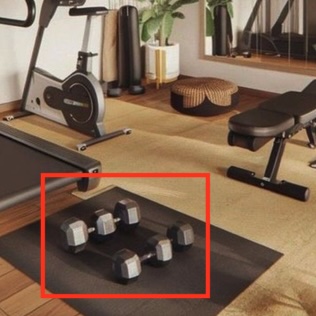
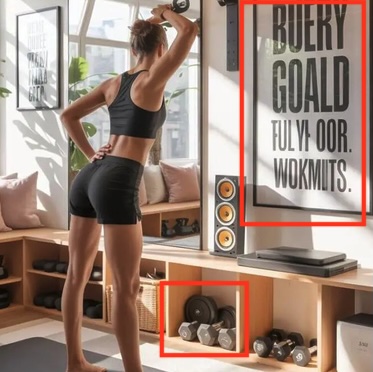
At a minimum, these images just feel off and do little to help imagine how to use a space I’m building. But what I find extremely frustrating is that what was once a go-to resource for me for home design is now almost useless. The time it takes to scroll and scroll and scroll to find relevant, authentic imagery doesn’t feel worth the squeeze. And honestly, I feel this is an early signal of how AI is making things harder rather than easier.
AI is being pushed at us from every direction. As someone who left big corporate America last year, I can speak firsthand how trainings were being conducted to use Co-Pilot and homegrown tools to do “less with more” and “be more efficient.” But my experience has been that if the type of work being outsourced to this technology isn’t being critically considered, it’s creating MORE work. If AI is being used to draft every email, presentation and creative concept, it means more mediocre content is being created and has to be sorted through. How hard do you have to dig for an original idea? And don’t get me started then if AI is also doing the sorting action…
Way back in 2008, I attended the Web 2.0 conference in San Francisco. I don’t remember a lot about the conference from almost 20 years ago but I do have a few clear memories that stand out. The first was being introduced to the founder of Foursquare as that app was just exploding. But the second was Mary Meeker’s keynote on Internet Trends. If you don’t know who Mary Meeker is, the short overview: she’s the expert on internet trends, has been for decades and continues to be. In that speech, she was discussing the impact smart phone cameras were having on the photography industry, especially the rate of new photos being created. Digital technology and smart phones were about to hockey-stick that growth.
I mean, it is wild to think that the camera was invented in 1827. That is just shy of 200 years ago. And in that 200 years, we’ve gone from just thousands of images in existence to millions in the 1980s. And then with the advent of digital, that velocity of creation hit the TRILLIONS in the smart phone era. Cumulative photos in existence hit 3.4 trillion by 2011 and 6.62 trillion by 2013!

There is no way for a human brain to even compute that much content. Now add the layer of complexity that AI-generated imagery adds.
In 2023, Everypixel counted about 34 million AI images generated every day. I can’t find anyone publishing a solid number since that source 3 years ago. For 2026, the estimates floating around guess at 80 million a day, but they’re aggregator numbers repeating each other rather than a fresh count. And honestly, with this technology in the hands of everyone, how could you ever count? Grandma is AI’ing herself as a Barbie doll, your nephew is using AI to publish fake Polaroids and your office mate just used Nano Banana to create an info-graphic for a PowerPoint presentation. There is no way to even begin to keep track of how many visuals were created in just the time it took you to read my blog post thus far.
It makes sense, in part, why so many data centers are being built. Our social networks and digital highways are being spammed with fake content at a level never seen before as businesses and scammers are trying to capitalize on the technology.
What is worse is that the act of labeling AI content is inherently flawed. Many sites (like Pinterest) have settings you can turn off but they don’t work. Sites (again, like Pinterest) even label AI-detected imagery – but it doesn’t catch much. I can’t tell you how many blatantly AI-generated animal rescue videos I’ve seen with comments from unsuspecting viewers gushing about “what a beautiful moment that was captured.”
In addition to that, there’s little regulation and even less in the way of disclosure requirements. We are left to sift through all of this ourselves. And we aren’t good at it. A Northwestern study with 50,000 participants found people spot AI images correctly about 76% of the time on average. In harder test cases, closer to 54%, basically a coin flip. Accuracy on individual images ranged from 32% to 99%. Some images fooled almost everyone.
Which takes me back to my beef with Pinterest and why I think it’s being ruined.
Personally, I think the interior design category is, at the moment, more susceptible to slop. There is rarely body anatomy to botch and lighting effects can be used to cover signs of fabrication. The other categories that I tend to follow are Outfits of the Day and Nail Art, which contain a very human component. As the technology gets better – and it does every day – expect that to change, too.
What I hate about all of this is that it creates yet another platform lacking authenticity. I go to Pinterest to find REAL ideas and inspiration that can be recreated with a level of confidence because someone already had done it. As these shifts take place, it will no longer be possible to have that confidence because we won’t know what is real, what has actually been done or what is just an illusion.
Back in 2007, I worked for BettyCrocker.com. One of my favorite parts about that job was our proximity to the kitchens where the professional cooks and bakers would vet every recipe before it hit a cookbook page because consumers needed to be able to trust that the food could be replicated. We took that science into featuring the first food blogger content on the site because we didn’t want to publish anything that couldn’t be trusted by a home cook.
I no longer work for General Mills. I don’t know that those same standards still exist. But I hope they do.
We are just at the beginning of the impact that AI-generated creative is having on our world. And it’s coming whether we want it to or not. But we don’t have to be complacent.
The power of AI can be harnessed. But that work needs to be thoughtful. How is it being used? What are the criteria? Where are the guardrails? As a professional, this is something I’m trying to lead by example through my own practice.
But we also need to pay attention. As content consumers, we need to be more vigilant than ever. Familiarize ourselves with the tell-tale signs of slop. Question everything. Don’t always take things at face value.
But more important than that, support real creatives. Be judicious in how the technology is used and pay artists for their work.
I truly believe that the backlash to all of this is a desire for authenticity. I’m getting more and more content in my Instagram feed about going analog. There was an article in The New Yorker last week about these “get it done” groups where people come together IN PERSON to check things off their individual to-do lists. I recently even purchased a boombox that plays CDs and cassettes so I can play my old, not-in-the-cloud media – and clearly there is a market for this b/c I found one.
In the end, I feel good about our remodel plan. Pinterest got me a part of the way, but the real conversations with real humans are getting me further. And when the project is complete, I am more than willing to share the actual photos of the actual work so that I can demonstrate to another 1/2 story homeowner what’s possible with a remodel.


Leave a Reply